
The March QI Update
How Easy Is It to Sue the Government When It Violates Your Rights?
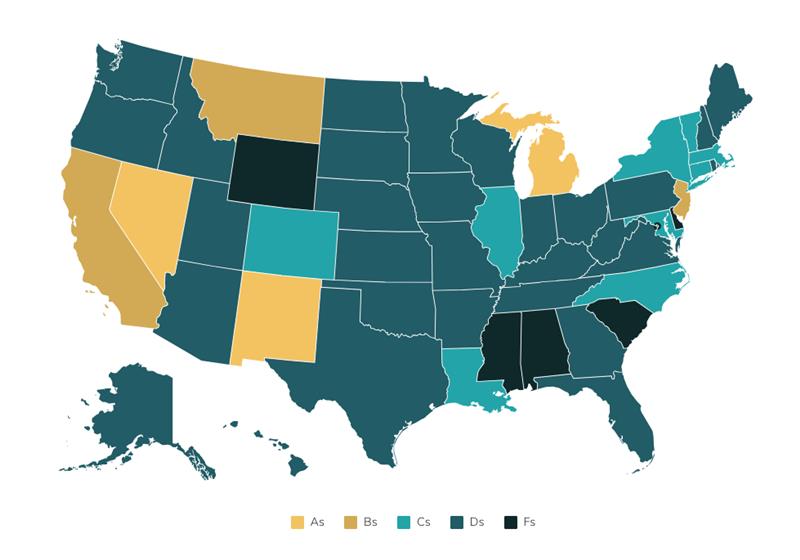
In 2022, our report 50 Shades of Government Immunity mapped the maze people face when bringing civil rights claims under state law. Even years later, one thing hasn’t changed: holding government officials accountable is still far harder than it should be.
The findings remain striking. Only eight states have standalone civil rights statutes—and even those are often weakened by layers of immunity. Just sixteen states allow claims directly under their constitutions, but confusing caselaw frequently shuts those cases down. And while most states technically permit tort claims against government officials, the reality is a patchwork of exceptions that makes winning nearly impossible.
The result? For many Americans, their rights exist more on paper than in practice. If we’re serious about ending qualified immunity and restoring civil rights, state-level reform can’t be overlooked. This report shows just how much work remains.
QI in the Courts
Each week, IJ’s Center for Judicial Engagement publishes Short Circuit —a newsletter and podcast that highlights notable federal court opinions. Each month, AAQI curates QI-related stories from Short Circuit and brings them to you here.
March 6th Newsletter
Fourth Circuit : A jury might have a look at the video of an Alleghany County, Va. deputy punching a suspect in the face 12 times—breaking his jaw, his orbital bone, and causing a brain bleed—and think that was unreasonable. No qualified immunity.
March 13th Newsletter
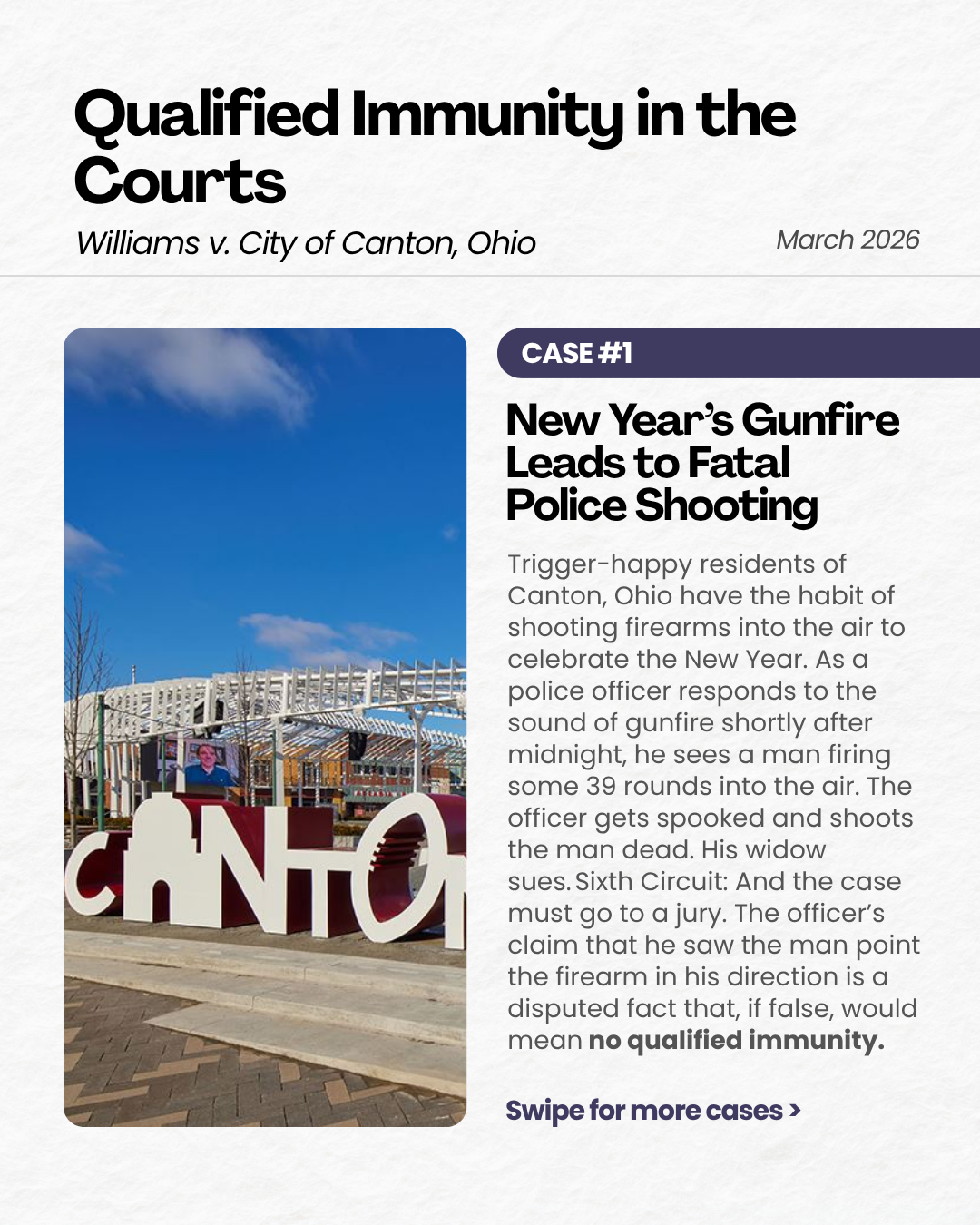
- Trigger-happy residents of Canton, Ohio have the habit of shooting firearms into the air to celebrate the New Year. As a police officer responds to the sound of gunfire shortly after midnight, he sees a man firing some 39 rounds into the air. The officer gets spooked and shoots the man dead. His widow sues. Sixth Circuit : The case must go to a jury.
- Allegation : Escambia County, Fla. cops don’t take required steps to verify missing-child report before heading to a home where the child might be found. Eleventh Circuit : No qualified immunity for gratuitous force and rummaging through drawers.
- The Ninth Circuit declined to reconsider its denial of qualified immunity involving a North Las Vegas officer who jumped a backyard fence while searching for a suspect.
March 20th Newsletter
During “reception and evaluation” period, all new inmates entering South Carolina prisons are confined to their cells nearly 24/7 for months. Fourth Circuit : No qualified immunity for prison staffers whose adherence to the policy caused severe suffering.
March 27th Newsletter
- Echols County, Ga. school officials allegedly retaliated against and fired a Black teacher on a pretext. Eleventh Circuit : No qualified immunity.
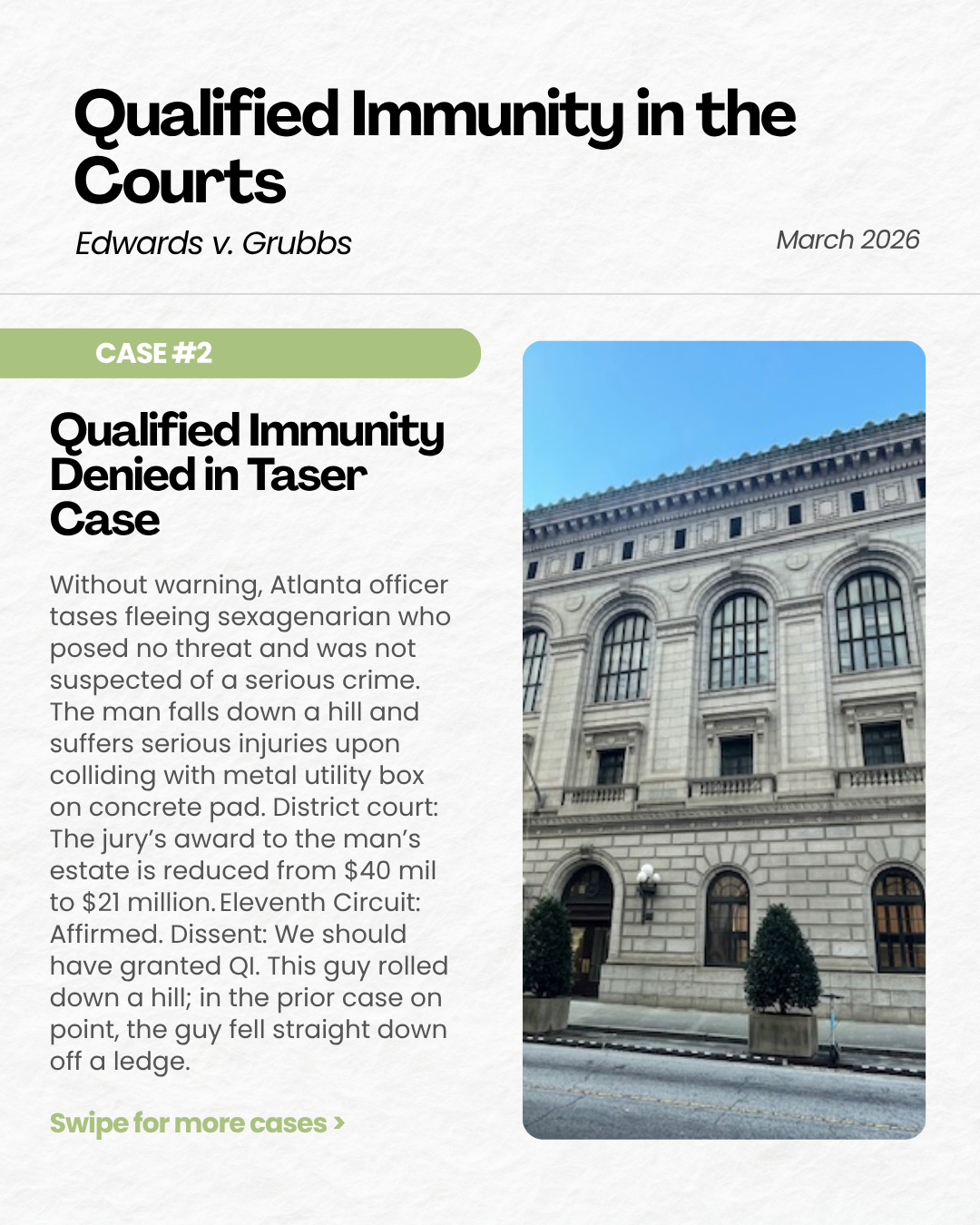
- Atlanta officer tases fleeing sexagenarian who posed no threat. Eleventh Circuit : Affirmed.
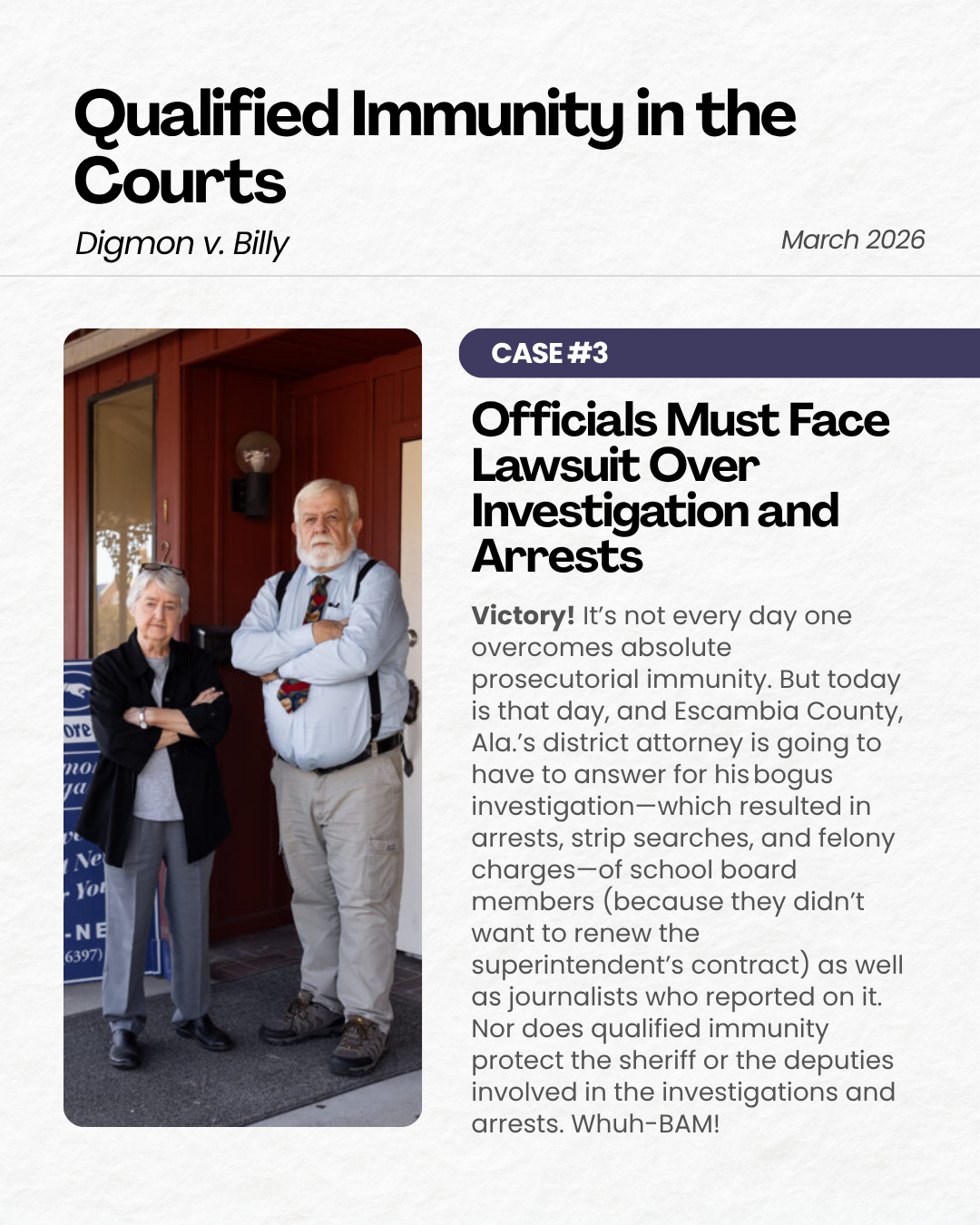
- Victory! Escambia County, Ala.’s district attorney must answer for a bogus investigation targeting school board members and journalists.
The February QI Update
Welcome to this month’s QI Update, a monthly roundup of key stories, cases, and developments shaping the fight against qualified immunity!
In Case You Missed It:
Watch This Episode of Beyond the Brief

Last month we highlighted a must-watch episode of the Institute for Justice’s Beyond the Brief : “Ending Qualified Immunity Will Improve Policing.” If you didn’t get a chance to watch it, now’s the perfect time.
In this conversation, retired LAPD lieutenant Jeff Wenniger , who served more than 30 years in law enforcement, joins IJ Senior Attorney Patrick Jaicomo to discuss what real accountability in policing looks like—for both the public and police officers themselves.
They explore why stronger accountability can actually improve policing, what many officers think about qualified immunity, and how ending unjust legal protections can help build trust between communities and law enforcement.
Watch the episode—and please share it with your networks!
QI in the Courts
Each week, IJ’s Center for Judicial Engagement publishes Short Circuit —a newsletter and podcast that highlights notable federal court opinions. Each month, AAQI curates QI-related stories from Short Circuit and brings them to you here.
If you would like to receive all of the opinion summaries each week, sign up here for the full Short Circuit newsletter.
February 6th Newsletter
- Arlington, Tex. police cadet suffers a fatal cardiac arrest during a self-defense training exercise at the academy. His wife sues the city and all the officers present, alleging violations of the Fourth and Fourteenth Amendments. Fifth Circuit : Qualified immunity.
February 13th Newsletter
- Kentucky woman calls 911 on her son after a dispute involving gasoline and a lighter. Police arrive and tase the man almost immediately. Sixth Circuit : Qualified immunity.
- Opa-Locka, Fla. man experiences an episode of erratic behavior. Officers allegedly tase, punch, and drag him while attempting to handcuff him. Eleventh Circuit : No qualified immunity for the most punch- and taser-happy officers.
February 20th Newsletter
- North Carolina prisoner is severely injured after being attacked by a dangerous inmate who should have been separated from the general prison population. Fourth Circuit : Enough evidence to proceed to trial on deliberate indifference claims.
- Two Cleveland police officers respond to a call about an armed man. One officer accidentally shoots his partner. Sixth Circuit : Qualified immunity.
February 27th Newsletter
- Victory! A federal court rejected a mayor and police chief’s invocation of qualified immunity after retaliatory arrests targeting a government critic. Learn more .
- Fifth Circuit grants qualified immunity after officers relied on information obtained from an allegedly unconstitutional cellphone search.
- Tenth Circuit : No qualified immunity for officers who used sweeping warrants to search protest-related digital data.
The January QI Update
Welcome to this month’s QI Update, a monthly roundup of key stories, cases, and developments shaping the fight against qualified immunity!
A Must-Watch:
“Ending Qualified Immunity Will Improve Policing”
In a recent episode of the Institute for Justice’s Beyond the Brief , a critical question takes center stage: What does real accountability in policing look like—for both the public and police officers themselves?
The episode features Jeff Wenniger, a retired LAPD lieutenant with more than 30 years in law enforcement, who now advocates for rethinking policing around trust, integrity, and genuine community partnership.
He’s joined by IJ Senior Attorney Patrick Jaicomo, who leads IJ’s efforts to dismantle qualified immunity and other legal doctrines that shield government officials from accountability.
Together, they discuss why greater accountability makes policing stronger, what many officers actually think about qualified immunity, and how ending unjust legal protections can improve policing for everyone.
QI in the Courts
Each week, IJ’s Center for Judicial Engagement publishes Short Circuit—a newsletter and podcast that highlights notable federal court opinions. Each month, AAQI curates QI-related stories from Short Circuit and brings them to you here.
January 2nd Newsletter
- New on the Short Circuit podcast: Find out what it’s like to litigate for people behind bars—including when they overcome qualified immunity.
- For weeks, staff at a secure, state-run Norwich, N.Y. facility for people with severe disabilities ignore man’s increasingly worrisome signs of heart disease, as well as his mother’s pleas to take him to a hospital. Per an expert, his death felt like drowning. Facility: Ah, but he was admitted voluntarily, so we didn’t have a constitutional duty of care to him. Second Circuit: Grant of qualified immunity reversed. To trial this must go.
January 9th Newsletter
- New on the Short Circuit podcast: What do Joan of Arc’s trial and qualified immunity have to do with each other? IJ’s Tahmineh Dehbozorgi explains.
- Baltimore SWAT officer shoots mentally ill veteran in the back, killing him. Officer: Because he was running at me with a machete. Fourth Circuit: Denial of QI affirmed. To trial this must go.
- Phoenix police encounter man behaving erratically. They subdue him and place him in a “RIPP” restraint, effectively hogtying him. After grunting, gasping, and falling limp, the man is placed facedown in the back of a patrol car. Shortly thereafter, he dies. His estate sues. Ninth Circuit: No qualified immunity.
January 23rd Newsletter
- Woman calls her mother to say that a man—her foe in a years-long legal dispute—was at her Kansas City, Kan. house, trying to kill her and her husband. Police arrive, find the couple shot to death. They set their sights on the woman’s foe. Yet no evidence linked him to the deaths, either at his home or theirs. He’s convicted anyway. A decade later, the state finally gets around to testing gunshot residue swabs, which reveal gunshot residue on the woman’s hand. Further investigation uncovers that a snitch’s testimony was bogus and a boatload of exculpatory evidence was missing from the case files. He’s released—and dies just a few months later. Tenth Circuit: No qualified immunity for the two lead investigators.
January 30th Newsletter
- Allegation: Reynoldsburg, Ohio officer grabs woman as she opens front door without giving her a chance to comply with order to step outside. When she tenses up and pulls back, he performs a takedown maneuver that results in injuries requiring four surgeries. District court: Could be excessive force. Sixth Circuit: Qualified immunity.
- During COVID-19 lockdowns in a California prison, one prisoner is forced to stay either in his cell or in a crowded work area with about 130 other inmates. He is denied outdoor recreation time. Ninth Circuit: And there’s no qualified immunity for the warden.
- Allegation: Macon County, Ala. deputy sheriff swings by the office while off duty, gets intoxicated, speeds homeward in his police truck, sans lights, and kills another driver. A violation of the driver’s due-process rights? Eleventh Circuit: We’re going to assume that the deputy was acting under color of state law. We’re also going to assume that the deputy’s conduct “shocked the conscience.” But he gets qualified immunity even so.
Best,
The AAQI team