End Qualified Immunity in Minnesota
Tell the Minnesota Legislature to stand up for our rights—end qualified immunity to protect Minnesotans.
Your message goes directly to your Minnesota state legislators.
What are the bills, and what do they do?
The Minnesota Civil Remedies Act would give people a real path to justice when all government—federal, state or local—actors violate our rights.
This bill is simple: If a local, state, or federal government employee violates Minnesotan’s rights (either in the federal Constitution, or in the Minnesota state Constitution) in the course of their work, the victim(s) can file a lawsuit, and the government cannot rely on qualified immunity to prevent the case from moving forward. Another bill, is similar, and would also allow victims of rights abuses from local, state, or federal government officials to file a lawsuit in court.
Both bills make a meaningful step in removing the first set of barriers to justice for victims by allowing Minnesotans to sue federal officials, who are often even more shielded from accountability than state and local government employees. While federal officials also get qualified immunity, courts often throw out cases against them before even getting to that point because of federal immunity from lawsuits, and these bills would both help address that injustice.
Noteably, The Minnesota Civil Remedies Act expressly removes qualified immunity from the equation. That matters, because even if lawsuits against government officials can get off the starting line, qualified immunity can still slam shut the courthouse doors before victims are allowed to really plead their case.Why now?
Accountability shouldn’t depend on headlines—but moments like this make the gaps impossible to ignore. Recent stories of aggressive operations have left many people asking the same question: if our rights are violated, what recourse is there? Too often, qualified immunity means the answer is none.
Minnesota can lead the nation. When our rights are violated, we deserve a path to justice. The Minnesota Civil Remedies Act opens the courthouse doors so victims of government abuse can finally be heard and government officials can be held to the same standards as everyone else. Minnesota has the chance to set a national standard for fairness, responsibility, and integrity.
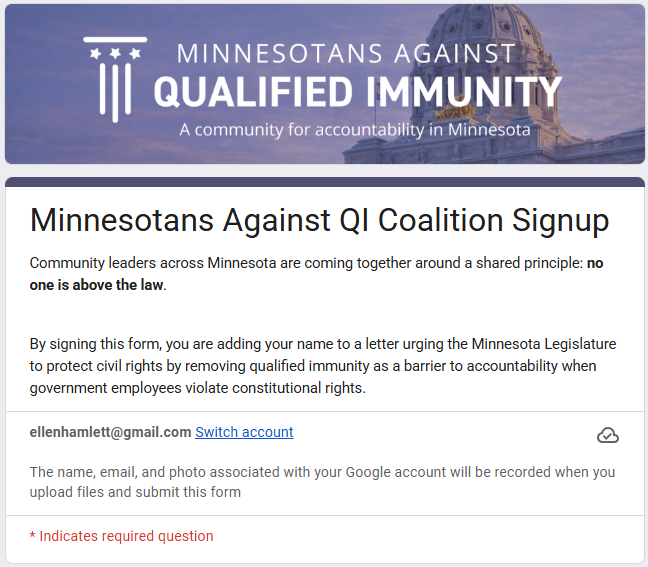
Join the Minnesota Accountability Coalition
Community leaders across Minnesota are coming together around a shared principle: no one is above the law.
By signing, you add your organization to a coalition urging the Minnesota Legislature to protect civil rights by removing qualified immunity as a barrier to accountability.
Sign the Coalition Letter ➜Opens in a new tab.
Partner With Us
The movement to end qualified immunity is strongest when we stand together. Americans Against Qualified Immunity (AAQI) partners with community leaders, advocacy groups, faith organizations, and public officials to push for meaningful accountability reform in Minnesota and across the nation.
Working with the Minnesota Justice Coalition
We’re proud to partner with the Minnesota Justice Coalition to advance real accountability and protect constitutional rights across the state.
Add your name to the petition to send the following letter to your legislators
Help us share the petition by text or social media
Sharing with your friends and family is simple: download the image and copy a message that you can send in a text to your friends and family or post online. If you’re willing, help us start a text chain—send to one friend and ask them to send it to a few more, and it grows from there.
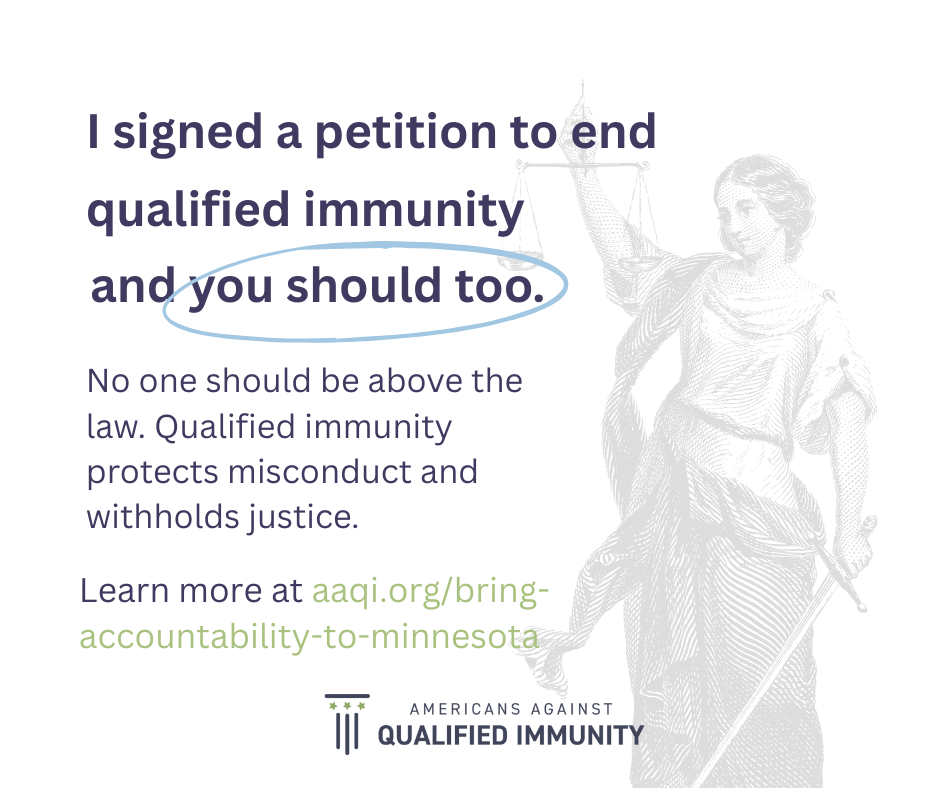
On iPhone/Android: if download doesn’t pop up, tap the image, then press & hold → Save Image.
Text options you can copy and paste:
Tip: send the image + one of these messages to 3 friends.
Copied!
Start the Conversation in Your Community
No One Should Be Above the Law is a discussion guide designed to help community members, faith leaders, and organizers talk about accountability and qualified immunity in Minnesota. It includes background information, discussion questions, and practical next steps for hosting a small-group conversation and taking action together.
Request a “Bring Accountability to Minnesota” Sign
Share your address so we can coordinate delivery. We’ll only use it for sign distribution.